UP Home Guard is a popular service opportunity for candidates who want to work in Uttar Pradesh and support the police and administration. Home Guards assist during law and order duties, traffic management, elections, festivals, emergencies, and other public safety activities.

The UP Home Guard salary is different from the fixed monthly salary of a regular government employee. Home Guards receive a duty allowance based on the number of days they are called for duty. This makes their monthly earnings dependent on their duty schedule.
UP Home Guard is a voluntary support force that works with the police and administration during different public safety situations.
Home Guards can be assigned duties related to security, traffic control, crowd management, election arrangements, disaster situations, and other government activities.
Common duties include:
The exact duties depend on the requirement and place of deployment.
The UP Home Guard salary mainly depends on the number of days an enrolled Home Guard performs duty. It is not the same as the fixed monthly salary structure of a regular state government employee.
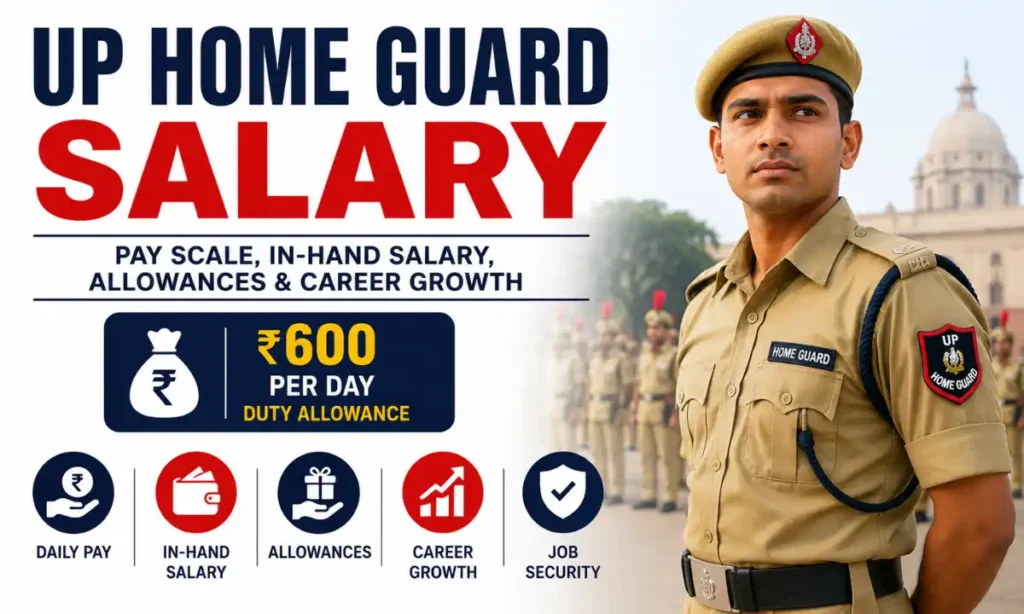
The current duty allowance is ₹600 per day. Applicable Dearness Allowance can also be provided according to government rules.
| Salary Component | Details |
|---|---|
| Duty Allowance | ₹600 per day |
| Monthly Earnings | Depends on duty days |
| Dearness Allowance | As applicable |
| Payment Basis | Duty-based |
| Government | Uttar Pradesh Government |
| Service Type | Home Guard Service |
The actual monthly earnings can change according to the number of days a Home Guard is deployed.
The main payment received by a UP Home Guard is the daily duty allowance. At ₹600 per duty day, a person performing more duty days will receive higher monthly earnings.
| Salary Component | Amount |
|---|---|
| Daily Duty Allowance | ₹600 |
| 10 Days Duty | ₹6,000 |
| 15 Days Duty | ₹9,000 |
| 20 Days Duty | ₹12,000 |
| 25 Days Duty | ₹15,000 |
| 30 Days Duty | ₹18,000 |
| Dearness Allowance | As applicable |
These calculations are based only on the daily duty allowance. Applicable Dearness Allowance and other eligible payments can increase the final amount.
The current UP Home Guard duty allowance is ₹600 per day when a Home Guard is called for duty.
Therefore, monthly earnings depend directly on the number of active duty days.
| Duty Days | Daily Allowance | Basic Duty Earnings |
|---|---|---|
| 10 Days | ₹600 | ₹6,000 |
| 15 Days | ₹600 | ₹9,000 |
| 20 Days | ₹600 | ₹12,000 |
| 25 Days | ₹600 | ₹15,000 |
| 30 Days | ₹600 | ₹18,000 |
The final payment can be higher after adding applicable Dearness Allowance and other eligible benefits.
There is no single fixed monthly salary for every UP Home Guard because the number of duty days can vary.
For example, a Home Guard completing 20 days of duty would receive ₹12,000 as the basic duty allowance. A person completing 30 days would receive ₹18,000 before applicable additional payments.
| Duty Days Per Month | Basic Duty Earnings |
|---|---|
| 10 Days | ₹6,000 |
| 15 Days | ₹9,000 |
| 20 Days | ₹12,000 |
| 25 Days | ₹15,000 |
| 30 Days | ₹18,000 |
The final amount depends on duty deployment and applicable government benefits.
The in-hand amount of a UP Home Guard mainly depends on the duty allowance earned during the month.
Since the payment is based on duty days, the amount received can be different every month.
| Duty Days | Basic Duty Earnings |
|---|---|
| 10 Days | ₹6,000 |
| 15 Days | ₹9,000 |
| 20 Days | ₹12,000 |
| 25 Days | ₹15,000 |
| 30 Days | ₹18,000 |
The actual amount can be higher after adding applicable Dearness Allowance and other eligible payments.
UP Home Guard service does not follow the same regular promotion structure as a permanent police or state government employee.
The role is based on enrollment and duty deployment. Therefore, candidates should not assume that regular government-style promotions automatically increase the monthly salary.
Career opportunities depend on government policies, service requirements, and available opportunities.
The exact career progression depends on the rules applicable to Home Guards in Uttar Pradesh.

Apart from the daily duty allowance, eligible Home Guards can receive applicable benefits according to government rules and the nature of their deployment.
The availability and amount of additional benefits can change according to government rules.
UP Home Guards assist the police and administration in maintaining public safety. Their work can change according to the local requirement and type of deployment.
The workload can vary according to the location and type of assignment.
Home Guard service provides an opportunity to gain experience in public safety and government-related duties.
However, Home Guard enrollment is different from appointment to a permanent police position.
The service can provide valuable experience in discipline, public safety, and field duties.
Candidates applying for UP Home Guard enrollment must meet the educational, age, physical, and other requirements mentioned in the recruitment notification.
The required qualification depends on the recruitment notification.
Candidates must have the prescribed educational qualification from a recognised board or institution.
The age requirement is specified in the relevant recruitment notification. Eligible reserved categories can receive age relaxation according to government rules.
Candidates should check the latest recruitment notification before applying.
The selection process can include different stages such as:
The exact selection stages depend on the applicable recruitment rules.
A Home Guard needs discipline, physical fitness, alertness, and the ability to work in different situations.
Important skills include:
These skills help Home Guards perform their duties effectively.
UP Home Guard service provides several benefits along with the duty allowance.
Some important benefits include:
The exact benefits depend on government orders and the nature of the duty.
Home Guard duty can be demanding because personnel may be deployed for different public safety responsibilities.
Some common challenges include:
Candidates should understand the duty-based nature of the role before applying.
UP Home Guard can be attractive for candidates who want government service experience and an opportunity to work in public safety.
The main advantages include:
The role can be useful for candidates interested in security, police support, and government service.
The monthly earnings of a UP Home Guard can change because the payment is connected to active duty.
Important factors include:
Therefore, two Home Guards may receive different amounts in the same month.
UP Home Guard and UP Police Constable are different types of government service.
A Police Constable is recruited to a regular police post with a fixed pay structure, while Home Guard payment is primarily based on duty allowance.
| Feature | UP Home Guard | UP Police Constable |
|---|---|---|
| Service Type | Home Guard Service | Regular Police Service |
| Salary Basis | Duty-Based | Fixed Pay Structure |
| Current Duty Payment | ₹600 Per Day | Regular Monthly Salary |
| Job Role | Police Support | Police Duties |
| Career Structure | Different from Regular Police | Regular Promotion System |
| Department | Home Guards | Uttar Pradesh Police |
Candidates should not consider these two positions identical because their service conditions and salary structures are different.
UP Home Guard can be a good opportunity for candidates who want to work in public safety and gain government-related service experience.
The role provides duty-based earnings, training, and experience working with police and administration.
However, candidates should remember that earnings depend on duty deployment and that Home Guard service is different from a permanent police appointment.
The UP Home Guard salary is mainly based on the number of days a Home Guard performs active duty. The current duty allowance is ₹600 per day, along with applicable Dearness Allowance.
For example, 20 days of duty would provide ₹12,000 as the basic duty allowance, while 30 days would provide ₹18,000 before adding applicable Dearness Allowance or other eligible payments.
UP Home Guard is different from a regular police job because the payment is duty-based rather than a fixed monthly salary. For candidates interested in public safety, police support, and government service experience, it can be a useful opportunity.
UP Home Guard payment is mainly based on duty days. The current duty allowance is ₹600 per day for active duty.
The current UP Home Guard duty allowance is ₹600 per day.
At ₹600 per day, 30 days of duty would provide ₹18,000 as the basic duty allowance before applicable Dearness Allowance and other eligible payments.
For 25 days of duty, the basic duty allowance at ₹600 per day would be ₹15,000.
Yes. Applicable Dearness Allowance can be provided along with the duty allowance according to government rules.
Home Guard service should not be treated as the same as a regular permanent police appointment. Its payment and service conditions are based on applicable Home Guard rules and duty deployment.
The career structure is different from regular police service. Opportunities and additional responsibilities depend on applicable Home Guard rules and government policies.
UP Home Guards can assist with traffic management, law and order support, election duties, festival security, crowd control, emergency operations, and other public safety duties.
Candidates must meet the educational qualification and other eligibility conditions mentioned in the relevant UP Home Guard recruitment notification.
It can be a good opportunity for candidates interested in public service, police support, and government-related field duties. However, candidates should understand that earnings depend on duty deployment.
Read More:
Air Hostess Salary in India: Salary Structure, In-Hand Pay, Allowances & Career Growth
Agniveer Salary in India: Salary Structure, In-Hand Pay, Allowances, Benefits & Career
SSC MTS Salary in India: Salary Structure, In-Hand Pay, Allowances & Career Growth

Being an Air Hostess is one of the most sought-after careers among candidates that love to work in the domain of aviation, travel, hospitality services, and a professional work atmosphere. The term "cabin crew" is also widely used in this field.

Air Hostess Salary varies from one airline to another and also depends upon other factors such as experience, flying hours, domestic or international route, and job designation. In this post, we have discussed the salary details related to being an Air Hostess in India.
Air Hostess is a cabin crew personnel who ensures the safety, comfort, and service to the passengers onboard.
Their role goes beyond merely serving the passengers with food and drinks. They are trained to carry out their safety responsibilities and provide assistance to the passengers during flights.
Common career positions include:
The exact designation depends on the airline and experience level.
The Air Hostess Salary in India is different from one airline to another. Fresher recruits earn less money as compared to experienced cabin crew employees, who earn much more.
Flight hours, international destinations, seniority level, and allowances also play a role in deciding the monthly earnings.
| Career Stage | Approx. Monthly Salary | Approx. Annual Salary |
|---|---|---|
| Trainee/Fresher | ₹25,000 – ₹40,000 | ₹3 Lakh – ₹4.8 Lakh |
| Junior Cabin Crew | ₹40,000 – ₹65,000 | ₹4.8 Lakh – ₹7.8 Lakh |
| Experienced Cabin Crew | ₹60,000 – ₹1,00,000 | ₹7.2 Lakh – ₹12 Lakh |
| Senior Cabin Crew | ₹80,000 – ₹1,20,000 | ₹9.6 Lakh – ₹14.4 Lakh |
| Purser/Cabin Supervisor | ₹1,00,000 – ₹2,00,000+ | ₹12 Lakh – ₹24 Lakh+ |
These figures are approximate. Actual earnings depend on the airline, flying schedule, experience, route, and applicable benefits.
The salary of an entry level air hostess basically comprises a fixed salary in addition to various allowances offered by the airline.
With experience, cabin crew members can move to senior positions and receive higher salaries.
| Salary Component | Details |
|---|---|
| Basic Salary | Fixed according to airline |
| Flying Allowance | Based on eligible flying hours |
| Layover Allowance | Provided during eligible layovers |
| Meal Allowance | According to airline policy |
| Performance Incentives | Based on airline policy |
| Other Benefits | According to employment terms |
The monthly salary can change because flying hours and other variable components are not necessarily the same every month.
Exposure is an essential component in the salaries of cabin crews. While freshers join as trainee or junior cabin crews, experienced cabin crews can advance to senior cabin crew positions.
| Experience | Position | Approx. Monthly Salary |
|---|---|---|
| 0–1 Year | Trainee/Fresher | ₹25,000 – ₹40,000 |
| 1–3 Years | Cabin Crew | ₹40,000 – ₹65,000 |
| 3–6 Years | Senior Cabin Crew | ₹60,000 – ₹1,00,000 |
| 6+ Years | Purser/Supervisor | ₹1,00,000 – ₹2,00,000+ |
The salary can be different for domestic and international airlines.
Various airlines offer various remuneration schemes depending on their business models, routes, location, and employment policies.
The domestic airlines typically pay lower basic salaries than most international airlines.
| Airline Type | Fresher Salary | Experienced Salary |
|---|---|---|
| Domestic Airlines | ₹25,000 – ₹50,000 | ₹50,000 – ₹1,20,000 |
| Premium Domestic Airlines | ₹35,000 – ₹60,000 | ₹70,000 – ₹1,30,000 |
| International Airlines | ₹80,000 – ₹1,50,000 | ₹1,50,000 – ₹2,50,000+ |
| Gulf Airlines | ₹1,20,000 – ₹2,50,000+ | ₹2,00,000 – ₹3,00,000+ |
These are indicative ranges and can vary according to the airline, experience, flying hours, currency, and employee benefits.
In-hand salary is what one gets after deduction.
A cabin crew may get a fixed salary, apart from other payments such as flying allowance, and benefits due to layovers. Hence, their salary can vary from month to month based on their schedule.
| Career Stage | Approx. In-Hand Salary |
|---|---|
| Fresher | ₹25,000 – ₹38,000 |
| Junior Cabin Crew | ₹35,000 – ₹60,000 |
| Experienced Cabin Crew | ₹50,000 – ₹90,000 |
| Senior Cabin Crew | ₹70,000 – ₹1,15,000 |
| Purser/Supervisor | ₹90,000 – ₹1,80,000+ |
The actual in-hand salary depends on the airline, salary structure, flying hours, and applicable deductions.

Allowances are an essential element of cabin crew salaries. Given that flight attendants travel often on the job, allowances for flight-related activities could be offered by the airlines.
These benefits can add considerable value to the overall compensation package.
An air hostess has an important responsibility for passenger safety and comfort. Cabin crew members are trained to handle normal flight operations as well as emergency situations.
Passenger safety remains one of the most important responsibilities of cabin crew.
Air Hostess is a career with several opportunities for professional growth. Employees can move into senior cabin crew and supervisory positions after gaining experience.
The exact promotion system varies from one airline to another.
Eligibility requirements differ between airlines. However, most airlines look for candidates with suitable education, communication skills, physical fitness, and a professional personality.
Candidates generally need:
A separate cabin crew course may not always be required because many airlines provide training after selection.
The age requirement depends on the airline and position. Freshers are generally recruited within the age range specified by the airline, while experienced candidates may be considered under different conditions.
Candidates should check the recruitment requirements of the airline before applying.
Airlines may have requirements related to:
The exact requirements vary from airline to airline.
The recruitment process can include:
Candidates who successfully complete the required stages can begin their training before joining regular flying duties.
Air hostesses interact with passengers from different backgrounds, so communication and interpersonal skills are very important.
Important skills include:
Cabin crew members should also be comfortable with changing schedules and frequent travel.
The profession offers several benefits in addition to the monthly salary.
Some common benefits include:
The exact benefits depend on the airline and employment contract.
Although the profession provides travel opportunities and attractive benefits, it also has several challenges.
Some common challenges include:
Candidates should consider these factors before choosing a cabin crew career.
Air hostess salary can be attractive because earnings may include both fixed and flight-related components.
The main advantages include:
International cabin crew positions can offer higher earning potential than many entry-level domestic roles.
Several factors can affect the monthly income of an air hostess.
Important factors include:
Because of these factors, two cabin crew members with similar experience may receive different salaries.
Air Hostess and Cabin Crew generally refer to the same type of aviation profession.
The term Air Hostess traditionally refers to female cabin crew members, while Cabin Crew is a gender-neutral term commonly used by airlines.
| Feature | Air Hostess | Cabin Crew |
|---|---|---|
| Meaning | Female cabin crew member | Gender-neutral term |
| Main Responsibility | Passenger safety and service | Passenger safety and service |
| Salary | Depends on airline | Depends on airline |
| Flying Allowance | Applicable | Applicable |
| Career Growth | Senior Crew, Purser, Supervisor | Senior Crew, Purser, Supervisor |
| Work Environment | Aircraft | Aircraft |
The salary is determined mainly by the airline, position, experience, and flying schedule.
Air Hostess can be a good career for candidates who enjoy travelling, meeting people, and working in the aviation industry.
The profession provides opportunities for salary growth, travel benefits, international exposure, and career advancement.
However, it also requires discipline, good communication, physical fitness, professional grooming, and the ability to work irregular hours.
Air Hostess is one of the well-known professions in the aviation sector and is associated with earnings, travels, allowances, and career advancement. An air hostess starting her career in India can earn between ₹25,000 and ₹40,000, and an experienced one earns even more.
Earnings will vary based on several factors like airline, experience, flying hours, route, job profile, and allowances. Foreign airlines provide better earning prospects as compared to most domestic jobs.
For those candidates who have good communication skills and who are interested in the aviation industry and travelling, air hosting is one of the best professions.
A fresher air hostess or cabin crew member can generally earn around ₹25,000 to ₹40,000 per month, depending on the airline and salary structure.
Experienced cabin crew members can earn around ₹60,000 to ₹1,00,000 or more per month, depending on their airline, position, and flying schedule.
Yes. Experienced cabin crew, senior crew members, pursers, and employees working on international routes can earn ₹1 lakh or more per month.
Common benefits can include flying allowance, layover allowance, meal allowance, transport support, accommodation during eligible layovers, travel benefits, and performance incentives.
A fresher can generally earn around ₹25,000 to ₹40,000 per month in domestic cabin crew roles, although the actual amount varies by airline.
Candidates generally need to complete Class 12 or an equivalent qualification. Airlines may also have requirements related to communication, physical fitness, grooming, and age.
No. Both men and women can work as cabin crew. Cabin Crew is the commonly used gender-neutral term for the profession.
Yes. Salary can increase with experience, higher flying hours, promotions, seniority, and opportunities with international airlines.
Many airlines offer discounted or complimentary travel benefits to eligible employees according to their employee travel policies.
Yes. It can be a good career for candidates interested in aviation, travelling, customer service, and an international work environment, provided they are comfortable with irregular schedules and cabin crew responsibilities.
Also, Read About:

Agniveer is a popular defence career option for young candidates who want to serve in the Indian Armed Forces. The Agnipath scheme provides a fixed monthly salary package, yearly salary growth, applicable allowances, and a Seva Nidhi package after completion of the engagement period.

The Agniveer salary increases every year during the four-year service period. In this article, you will learn about Agniveer salary, in-hand salary, year-wise salary structure, allowances, Seva Nidhi package, job profile, eligibility, benefits, and career growth.
An Agniveer is a person recruited into the Indian Armed Forces under the Agnipath scheme for a fixed period of four years.
Agniveers can be recruited into different services and trades depending on the recruitment requirements. Their duties include military training, physical activities, discipline, operational support, and other responsibilities assigned by their service.
Agniveers can serve in:
The exact duties depend on the service, trade, rank, and posting.
Agniveer salary follows a fixed four-year structure. The monthly package starts at ₹30,000 in the first year and increases to ₹40,000 in the fourth year.
A part of the monthly package is contributed to the Agniveer Corpus Fund, while the remaining amount is provided as the in-hand component.
| Service Year | Monthly Package | In-Hand Component | Corpus Contribution |
|---|---|---|---|
| 1st Year | ₹30,000 | ₹21,000 | ₹9,000 |
| 2nd Year | ₹33,000 | ₹23,100 | ₹9,900 |
| 3rd Year | ₹36,500 | ₹25,550 | ₹10,950 |
| 4th Year | ₹40,000 | ₹28,000 | ₹12,000 |
The monthly package increases each year, giving Agniveers a gradual increase in their earnings during the four-year engagement.
Read More: SSC MTS Salary || Loco Pilot Salary || SBI PO Salary
The Agniveer salary is designed to increase every year. The first-year package is ₹30,000 per month, while the fourth-year package reaches ₹40,000 per month.
A fixed portion of the package is deposited into the Agniveer Corpus Fund. The Government also contributes an equal amount to the corpus.
| Salary Component | 1st Year | 2nd Year | 3rd Year | 4th Year |
|---|---|---|---|---|
| Monthly Package | ₹30,000 | ₹33,000 | ₹36,500 | ₹40,000 |
| In-Hand Component | ₹21,000 | ₹23,100 | ₹25,550 | ₹28,000 |
| Agniveer Contribution | ₹9,000 | ₹9,900 | ₹10,950 | ₹12,000 |
| Government Contribution | ₹9,000 | ₹9,900 | ₹10,950 | ₹12,000 |
The in-hand component represents 70% of the monthly package. The remaining 30% is contributed to the corpus fund.
Agniveer salary increases according to the predefined four-year structure.
The monthly package becomes higher with every year of service.
| Service Year | Monthly Package | Monthly In-Hand |
|---|---|---|
| First Year | ₹30,000 | ₹21,000 |
| Second Year | ₹33,000 | ₹23,100 |
| Third Year | ₹36,500 | ₹25,550 |
| Fourth Year | ₹40,000 | ₹28,000 |
This yearly increase allows Agniveers to receive higher monthly earnings as they gain more experience during their service.
Seva Nidhi is an important financial benefit provided after completion of the four-year Agniveer engagement.
During the service period, the Agniveer contributes a portion of the monthly package to the Agniveer Corpus Fund. An equal contribution is made by the Government.
| Particular | Amount |
|---|---|
| Agniveer Contribution | Approximately ₹5.02 lakh |
| Government Contribution | Approximately ₹5.02 lakh |
| Total Seva Nidhi | Approximately ₹10.04 lakh |
| Interest | As applicable |
The final amount can include applicable interest according to the scheme rules.
The Seva Nidhi provides financial support to Agniveers after completion of their four-year engagement.

Agniveers can receive applicable allowances in addition to their monthly salary package.
The exact allowances depend on the service, location, nature of duty, and applicable defence rules.
These allowances provide additional financial support during the period of service.
Agniveer in-hand salary is the amount received from the monthly package after the corpus contribution.
The standard in-hand component starts at ₹21,000 in the first year and reaches ₹28,000 in the fourth year.
| Service Year | Monthly Package | In-Hand Salary |
|---|---|---|
| 1st Year | ₹30,000 | ₹21,000 |
| 2nd Year | ₹33,000 | ₹23,100 |
| 3rd Year | ₹36,500 | ₹25,550 |
| 4th Year | ₹40,000 | ₹28,000 |
The actual amount received can vary depending on applicable allowances and service-related conditions.
The job profile of an Agniveer depends on the service and trade. Every Agniveer receives military training and is expected to maintain discipline and physical fitness.
The responsibilities can be different for Army, Navy, and Air Force Agniveers.
Agniveer engagement is for four years. After completing the engagement period, eligible candidates can get an opportunity for selection into the regular cadre.
Selection for regular service is not automatic and depends on performance, organisational requirements, vacancies, and applicable service rules.
Those who are not selected for regular service complete their engagement and receive the applicable exit benefits.
Eligibility requirements depend on the service and category for which a candidate applies.
Candidates need to meet the required educational, age, physical, and medical standards.
The qualification depends on the selected category.
Candidates may need:
The exact educational requirement varies between Army, Navy, and Air Force recruitment.
The age limit depends on the recruitment cycle and service.
Candidates should check the relevant recruitment notification for the prescribed age range and applicable relaxation.
The selection process can include:
The exact process depends on the service and category.
Agniveer service requires physical fitness, discipline, mental strength, and teamwork.
Important skills include:
Candidates should also be comfortable working in challenging and disciplined environments.
Agniveers receive several benefits along with their monthly salary package.
Some important benefits include:
These benefits make the Agniveer scheme attractive to candidates interested in defence careers.
Agniveer service can be physically and mentally demanding. Candidates have to follow strict military discipline and may work in challenging conditions.
Some common challenges include:
Candidates should understand these factors before choosing the Agniveer career path.
Agniveer salary is attractive because the monthly package increases every year and comes with additional financial benefits.
The main advantages include:
The combination of salary, training, financial support, and defence experience makes the scheme appealing to many young candidates.
The basic salary structure is fixed according to the year of service, but total benefits can vary according to different factors.
Important factors include:
Therefore, the monthly package and additional benefits should be considered separately when calculating total earnings.
Agniveer service and regular defence service are different types of employment.
Agniveers initially serve for a fixed four-year period, while personnel selected for regular cadre continue under regular service conditions.
| Feature | Agniveer | Regular Defence Personnel |
|---|---|---|
| Service Type | Fixed Engagement | Regular Service |
| Initial Period | 4 Years | Long-Term Service |
| Salary Structure | Customised Package | Regular Pay Structure |
| Seva Nidhi | Applicable | Different Benefit Structure |
| Pension | Not Applicable for Agniveer Tenure | Subject to Applicable Rules |
| Career Continuation | Selection-Based | Regular Service |
Agniveers should understand that completing four years does not automatically result in permanent defence employment.
Read More: Merchant Navy Salary || Cisf Salary
Agniveer can be a good career option for young candidates who want military training, defence experience, financial benefits, and an opportunity to serve the country.
The scheme provides a structured salary package and a Seva Nidhi benefit after four years.
However, candidates should also understand that regular service is not guaranteed. Only eligible candidates selected according to the applicable service rules can continue in the regular cadre.
Agniveer salary follows a fixed four-year structure under the Agnipath scheme. The monthly package starts at ₹30,000 in the first year and increases to ₹40,000 in the fourth year.
The standard in-hand component increases from ₹21,000 in the first year to ₹28,000 in the fourth year. Agniveers can also receive applicable allowances and other service-related benefits.
After completing four years, eligible Agniveers receive the applicable Seva Nidhi package. The scheme also provides valuable military training, skills, and defence experience.
For young candidates interested in joining the Armed Forces, Agniveer can be a useful career opportunity, especially for those who are prepared for the physical demands and fixed-term nature of the service.
The starting monthly package of an Agniveer is ₹30,000, with a standard in-hand component of ₹21,000 after the corpus contribution.
The monthly package in the fourth year is ₹40,000, with a standard in-hand component of ₹28,000.
The standard in-hand component is ₹21,000 in the first year, ₹23,100 in the second year, ₹25,550 in the third year, and ₹28,000 in the fourth year.
Agniveers can receive applicable Risk and Hardship Allowance, Dress Allowance, Travel Allowance, ration-related benefits, and other service-specific allowances.
The Seva Nidhi package is approximately ₹10.04 lakh excluding applicable interest, based on the standard Agniveer and Government contributions.
Agniveers do not receive pension benefits for the four-year Agniveer engagement.
Yes. Agniveers are provided life insurance coverage during their engagement according to the applicable scheme rules.
The standard Agniveer engagement period is four years.
Agniveers are not automatically made permanent after four years. Eligible candidates can be selected for regular service according to the applicable service rules and organisational requirements.
Agniveer can be a good option for candidates who are interested in defence service, military training, discipline, and gaining experience in the Armed Forces.
CTC stands for Cost to Company. It is the total annual amount a company spends on an employee, not the amount the employee receives in hand.
A typical CTC includes:
Example:
Lorem Ipsum is simply dummy text of the printing and typesetting industry. Lorem Ipsum is simply dummy text of the printing and typesetting industry. Lorem Ipsum is simply dummy text.
© Copyright 2026 by Blogger WordPress Theme. All right reserved